
Why Developing Countries Are Growing Faster Than Rich Nations
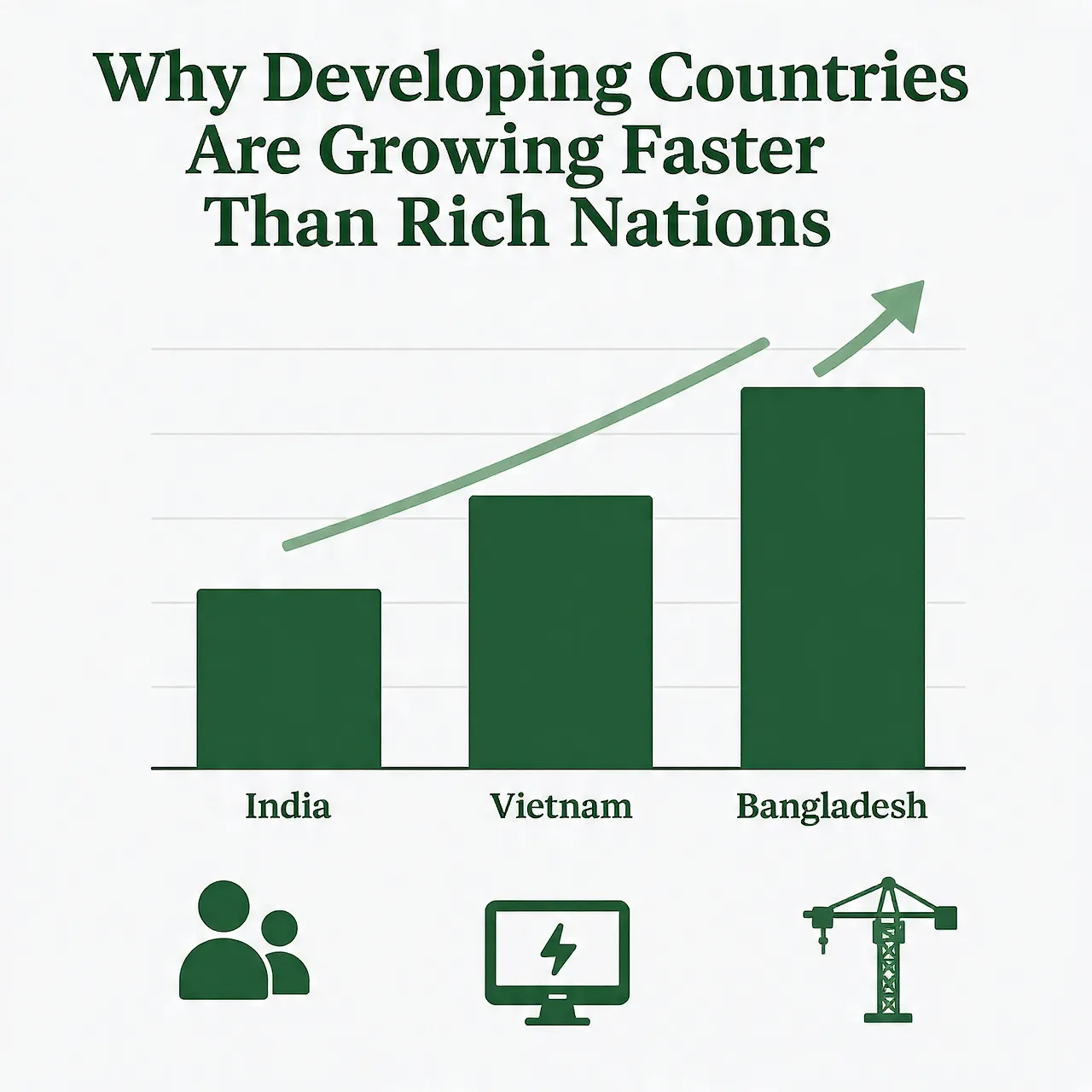
By 2026, a remarkable economic trend is reshaping the global landscape: developing countries are growing faster than traditionally rich nations. While developed economies like the US, Germany, and Japan experience slower growth due to mature markets and aging populations, countries in Asia, Africa, and Latin America are emerging as engines of global growth.
This article explores why developing countries are outpacing rich nations, analyzing demographics, consumption patterns, urbanization, and technology leapfrogging, and what this means for investors, businesses, and the global economy.
1. Demographics: The Youth Dividend
Young and Growing Populations
-
Developing nations have significantly younger populations than rich nations.
-
Countries like India, Nigeria, and Indonesia have median ages below 30, while Japan, Germany, and Italy have median ages above 45.
Why Youth Matters
-
Labor Force Expansion: Young populations expand the workforce, boosting productivity and economic output.
-
Consumer Base Growth: Millennials and Gen Z drive demand for tech, entertainment, healthcare, and retail.
-
Entrepreneurship Potential: Young populations are more likely to innovate, start businesses, and adopt new technologies.
Example: India’s working-age population is projected to surpass China’s by 2026, providing a demographic tailwind for decades.
Challenges
-
Youth unemployment can become a risk if skills do not match market demands.
-
Governments need to invest in education, training, and health infrastructure to fully harness the youth dividend.
2. Consumption: Rapidly Expanding Middle Class
Rising Purchasing Power
-
Developing countries are witnessing a booming middle class with increasing disposable income.
-
Spending is rising on electronics, automobiles, housing, education, and digital services.
Consumption as Growth Engine
-
Domestic demand reduces reliance on exports, making economies more resilient to global shocks.
-
Rising consumption attracts foreign investment and multinational corporations, fueling further growth.
Examples
-
Vietnam and India are experiencing a surge in e-commerce, mobile payments, and consumer electronics sales.
-
African markets like Nigeria and Kenya are seeing rapid adoption of mobile banking and digital services, driving local economies.
Insight: A growing middle class accelerates internal economic growth, creating self-sustaining cycles of demand and investment.
3. Urbanization: The Engine of Productivity
Rapid City Growth
-
Developing countries are urbanizing faster than rich nations.
-
Cities act as hubs for industry, innovation, and services, concentrating talent and resources.
Benefits of Urbanization
-
Economies of Scale: Dense populations reduce infrastructure costs per capita and improve service delivery.
-
Innovation Hubs: Urban centers foster technology clusters, startups, and entrepreneurship ecosystems.
-
Infrastructure Investment: Roads, ports, energy, and digital infrastructure expand economic capacity.
Examples
-
India: Cities like Bengaluru, Hyderabad, and Pune are global tech hubs.
-
Nigeria: Lagos is a growing commercial and fintech center.
-
Vietnam: Ho Chi Minh City and Hanoi attract manufacturing, services, and foreign investment.
Challenge: Rapid urbanization can create slums, traffic congestion, pollution, and housing shortages, requiring effective urban planning.
4. Technology Leapfrogging: Skipping Stages
What Is Leapfrogging?
-
Developing countries often bypass traditional infrastructure stages, adopting advanced technology directly.
Examples
-
Mobile Payments: Africa skipped traditional banking, adopting mobile money through platforms like M-Pesa.
-
Renewable Energy: Solar microgrids in rural India and Africa bypass traditional fossil-fuel grids.
-
E-Commerce & Delivery: Fast adoption of digital platforms enables startups to compete globally.
Why Leapfrogging Accelerates Growth
-
Reduces infrastructure costs while expanding access to services
-
Enables rapid inclusion of rural and underserved populations in the economy
-
Drives entrepreneurship and innovation without waiting for legacy systems
Example: In India, millions access banking and financial services via mobile phones without ever visiting a bank branch—a phenomenon still uncommon in some developed nations.
5. Other Factors Contributing to Faster Growth
5.1 Foreign Investment and Trade
-
Developing countries attract foreign direct investment (FDI) in tech, manufacturing, and services.
-
Participation in global value chains allows them to manufacture, export, and innovate competitively.
5.2 Government Reforms
-
Pro-business policies, tax incentives, and investment in infrastructure boost productivity.
-
Examples:
-
Vietnam’s manufacturing incentives for electronics and apparel
-
India’s ease-of-doing-business reforms and startup-friendly policies
-
5.3 Natural Resources and Energy
-
Many developing nations have abundant natural resources, supporting industrial growth and exports.
-
Investments in renewable energy provide cheap, scalable power to fuel industries.
6. Challenges to Sustained Growth
While growth is impressive, developing countries face structural challenges:
-
Inequality: Income gaps between urban and rural areas, and rich vs. poor, can create social tensions.
-
Education & Skills Gap: Workforce training must match rapidly evolving industries.
-
Political & Economic Stability: Policy uncertainty, corruption, or regional conflicts can slow growth.
-
Climate Risks: Extreme weather, floods, and droughts disproportionately affect developing nations.
Insight: Growth is fastest in countries that combine demographics, technology, and reforms with political and social stability.
7. Comparing Growth Prospects: Developing vs Rich Nations
| Factor | Developing Countries | Rich Nations |
|---|---|---|
| Demographics | Young, growing population | Aging, shrinking workforce |
| Consumption | Rapidly expanding middle class | Saturated markets |
| Urbanization | Fast, driving industrial clusters | Mature, slower urban growth |
| Technology | Leapfrogging, rapid adoption | Incremental innovation, legacy systems |
| Investment | High FDI and global interest | Slower relative growth |
| Challenges | Infrastructure, governance, inequality | Market saturation, slow innovation |
Takeaway: Developing countries combine demographic tailwinds with technological adoption to outpace slower-growing, mature economies.
Conclusion
By 2026, the fastest-growing economies are not the richest, but the youngest, most adaptable, and tech-savvy nations. Factors fueling their growth include:
-
Demographics: Large, youthful populations expanding labor and consumer markets.
-
Consumption: Rising middle-class spending driving domestic demand.
-
Urbanization: Concentrated economic activity improving productivity and innovation.
-
Technology Leapfrogging: Skipping legacy infrastructure to adopt modern solutions rapidly.
Countries like India, Vietnam, Nigeria, Kenya, and Indonesia are emerging as global growth engines, attracting investment, talent, and innovation.
While challenges remain—inequality, climate risk, and governance—these nations are poised to reshape global economic dynamics, narrowing the gap with rich nations and potentially defining the next era of global economic leadership.