
How Indias UPI System Is Influencing Global Digital Payments
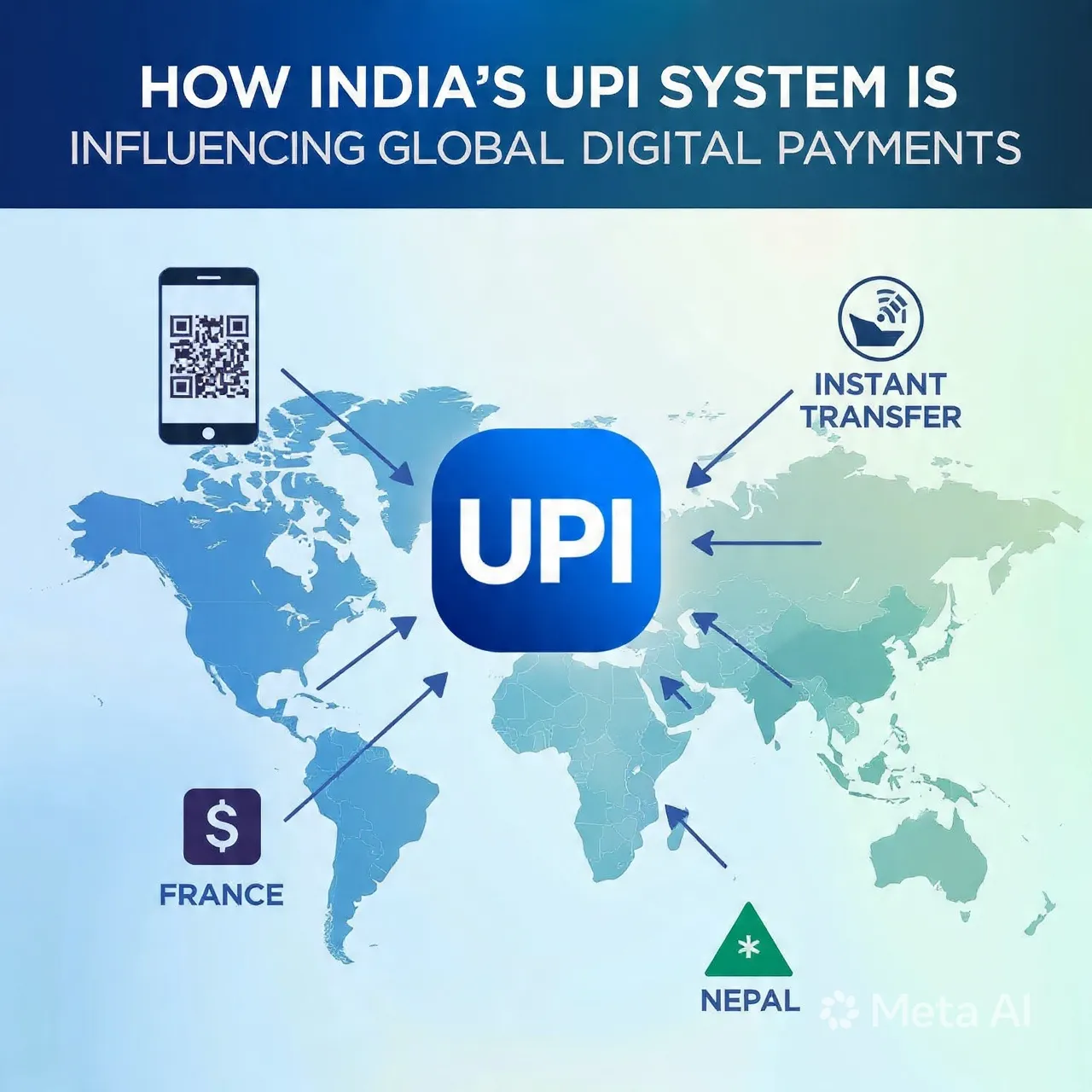
Since its launch in 2016, India’s Unified Payments Interface (UPI) has transformed the way billions of Indians transact digitally. By 2026, UPI has become more than a domestic success—it is a model influencing global digital payments, drawing attention from governments, central banks, and fintech innovators worldwide.
This article explores why UPI works, how it impacts financial inclusion, and why other countries are adopting or studying India’s model, reshaping the global payments landscape.
1. What Makes UPI Revolutionary
Instant and Interoperable Payments
-
UPI allows real-time money transfers between any two bank accounts using a mobile phone.
-
Unlike traditional digital wallets or bank apps, UPI is interoperable across banks and apps, enabling seamless transactions.
Low-Cost Transactions
-
UPI transactions are free or extremely low-cost, making them accessible to all income segments.
-
No transaction fees or hidden charges encourage widespread adoption.
Ease of Use
-
Users can send or receive money with just a virtual payment address (VPA), QR code, or mobile number.
-
Minimal technical barriers allow even first-time smartphone users to transact digitally.
Integration with Services
-
UPI supports bill payments, e-commerce, in-store payments, lending, and investment platforms.
-
Its ecosystem enables businesses to collect payments instantly, reducing dependency on cash.
Insight: UPI combines speed, simplicity, low cost, and interoperability, making it far more than just a payment method—it’s a digital payments infrastructure.
2. Financial Inclusion: Reaching the Unbanked
Mass Adoption
-
UPI has onboarded over 500 million users in India by 2026.
-
It allows people in rural areas, previously reliant on cash, to participate in the formal economy.
Benefits for Small Businesses
-
UPI enables micro and small merchants to accept digital payments without expensive Point of Sale (POS) terminals.
-
Instant settlement increases liquidity and reduces dependency on credit.
Government Initiatives
-
India’s government integrates UPI with subsidy transfers, tax payments, and welfare schemes, demonstrating its versatility.
Global Lesson: Countries seeking financial inclusion and cashless economies are studying UPI to replicate its success in bridging the unbanked and underbanked populations.
3. Why Other Countries Are Adopting or Studying UPI
3.1 Cost-Effective Payment Infrastructure
-
Traditional card networks are expensive and fragmented, especially in developing nations.
-
UPI offers a low-cost alternative, reducing infrastructure costs while enabling mass digital adoption.
3.2 Interoperability and Standardization
-
UPI works across banks, apps, and platforms, creating a unified ecosystem.
-
Countries with fragmented banking systems see UPI as a model to connect multiple financial institutions seamlessly.
3.3 Real-Time Settlement
-
UPI transactions settle instantly, improving cash flow for businesses and consumers.
-
Governments and central banks value real-time systems for reducing fraud, increasing transparency, and monitoring payments.
3.4 Open API Ecosystem
-
UPI’s open API system allows fintech startups to innovate and build apps on top of the payment network.
-
This fosters competition, innovation, and convenience for end-users.
4. Countries Adopting or Exploring UPI-Like Systems
4.1 Singapore and Southeast Asia
-
Singapore is exploring interoperable payment systems inspired by UPI.
-
Other ASEAN countries are considering QR-based payments and bank-neutral mobile payment platforms.
4.2 United Kingdom
-
The UK’s Faster Payments Service and proposals for real-time retail payment rails draw lessons from UPI’s interoperability and low fees.
4.3 Middle East and Africa
-
Countries like the UAE and Kenya are piloting mobile-first, bank-agnostic payment systems.
-
Africa’s M-Pesa-inspired ecosystems benefit from India’s digital identity and UPI integration insights.
4.4 Latin America
-
Brazil and Mexico are examining UPI to improve real-time retail payments and boost financial inclusion.
Insight: UPI serves as a global benchmark for governments and fintech innovators seeking efficient, inclusive, and scalable digital payments systems.
5. UPI and Global Digital Payments Trends
5.1 QR Codes and Mobile Payments
-
QR code-based payments, popularized by UPI, are now standard in many developing and developed nations.
5.2 Bank-Neutral Platforms
-
UPI shows that payment networks do not need to be tied to a single bank or card provider, promoting competition and innovation.
5.3 Instant Peer-to-Peer and Peer-to-Merchant Payments
-
P2P payments are increasingly real-time globally, influenced by UPI’s rapid adoption.
5.4 Integration With Fintech Services
-
Lending, wealth management, bill payments, and e-commerce are increasingly integrated into payment platforms, following UPI’s ecosystem approach.
Insight: UPI’s model demonstrates that a low-cost, interoperable, real-time system can transform national payment behaviors faster than card-based networks.
6. Challenges and Lessons
Cybersecurity and Fraud
-
Rapid adoption increases the risk of phishing, account hacking, and transaction fraud.
-
UPI’s success relies on robust fraud detection and user education.
Regulatory Balance
-
Open systems like UPI require centralized regulation to prevent misuse while maintaining innovation.
Scalability
-
Maintaining high-volume, low-latency transactions for hundreds of millions of users is technically challenging.
-
Other countries need strong infrastructure before replicating India’s model.
Lesson: Technology alone is not enough—regulation, infrastructure, and user trust are equally critical.
7. Conclusion
India’s UPI system is reshaping global digital payments, offering lessons in:
-
Financial inclusion: Bringing the unbanked into the digital economy.
-
Low-cost, interoperable infrastructure: Reducing reliance on expensive card networks.
-
Instant settlement and convenience: Empowering consumers and businesses alike.
-
Open ecosystems for innovation: Encouraging fintech startups and integrated services.
By 2026, countries around the world—from Southeast Asia to Africa, Latin America, and Europe—are adopting, adapting, or studying India’s UPI model. Its influence highlights a critical shift: the future of digital payments is real-time, low-cost, inclusive, and technologically agile.
India’s success story shows that a well-designed digital payments system can drive economic inclusion, innovation, and global recognition, offering a roadmap for nations seeking to modernize their financial infrastructure.