
Donald Trump and U.S. China Military Tensions
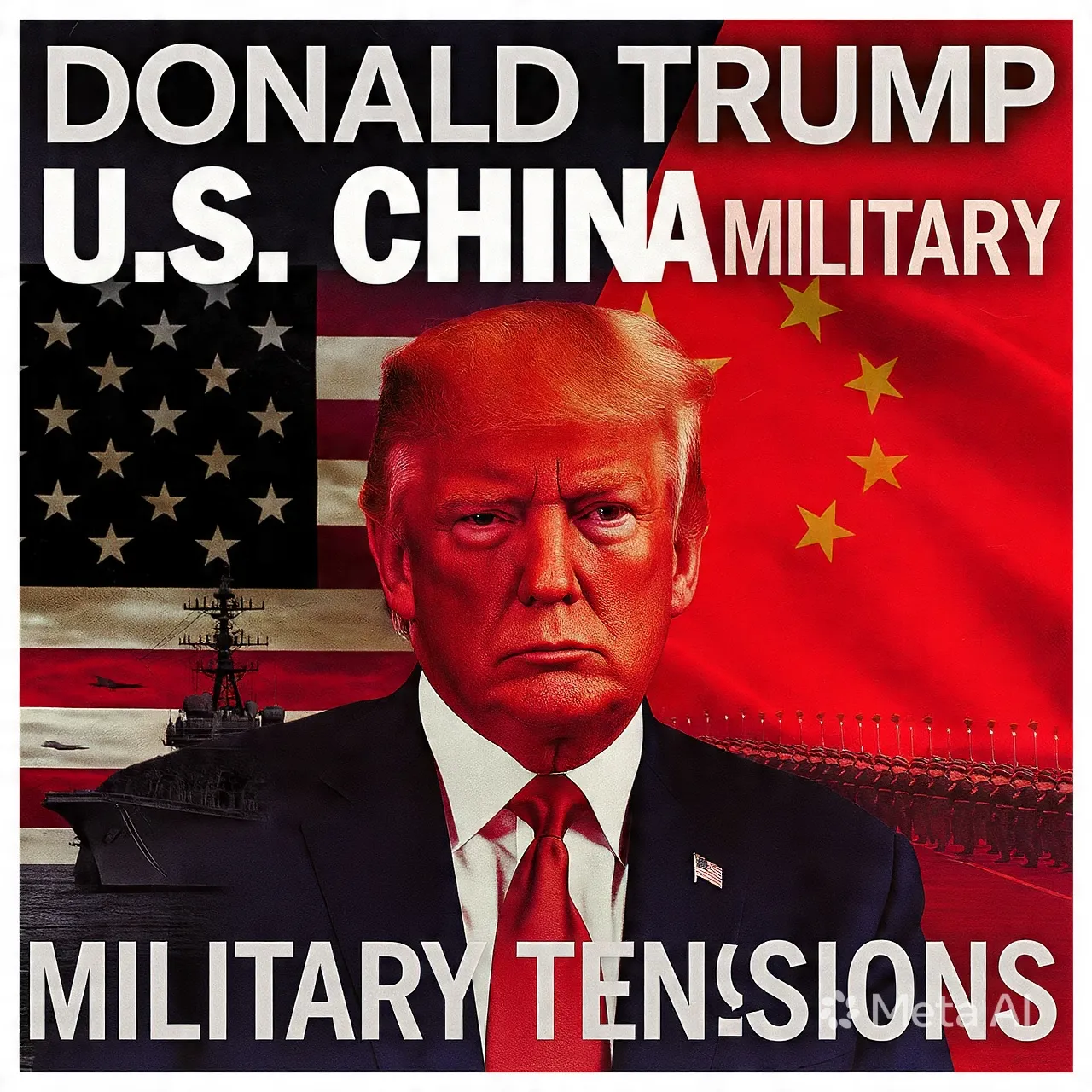
The relationship between the United States and the People’s Republic of China has evolved into the defining geopolitical rivalry of the 21st century. Under the leadership of Donald Trump, U.S.–China relations shifted from cautious economic interdependence to overt strategic competition. Military tensions intensified across multiple domains — maritime, cyber, space, and technological — reshaping the global security environment.
This article provides a comprehensive analysis of Trump’s approach to China, the military dimensions of the rivalry, flashpoints such as Taiwan and the South China Sea, and the broader implications for global stability.
1. Strategic Context: From Engagement to Competition
For decades, U.S. policy toward China was based on engagement — integrating Beijing into global trade institutions in hopes that economic liberalization would moderate political behavior.
Trump rejected this premise. His administration formally labeled China a “strategic competitor,” marking a doctrinal shift away from cooperation toward rivalry.
This transformation had three pillars:
-
Economic confrontation (tariffs and trade restrictions)
-
Technological decoupling (export controls, semiconductor restrictions)
-
Military reinforcement in the Indo-Pacific
The military dimension became central to deterrence strategy.
2. The Indo-Pacific as the Primary Theater
Trump’s administration elevated the Indo-Pacific as the central geopolitical arena.
A. Freedom of Navigation Operations (FONOPs)
The U.S. Navy increased operations in contested waters, especially in the South China Sea, challenging China’s expansive maritime claims.
Beijing had militarized artificial islands and expanded naval patrols. Washington responded with:
-
Increased naval deployments
-
Strategic bomber flights
-
Joint exercises with regional allies
The objective: prevent China from transforming disputed waters into de facto sovereign territory.
B. Strengthening Regional Alliances
Trump emphasized burden-sharing but also deepened security ties in Asia, including:
-
Expanded cooperation with Japan
-
Strategic coordination with Australia
-
Revival of the Quad framework (U.S., Japan, India, Australia)
The Quad became an informal balancing coalition against Chinese expansionism.
3. Taiwan: The Most Volatile Flashpoint
Taiwan represents the most sensitive and potentially explosive issue in U.S.–China relations.
Under Trump:
-
Arms sales to Taiwan increased significantly.
-
High-level diplomatic visits expanded.
-
Military cooperation became more visible.
Beijing views Taiwan as a breakaway province and has not ruled out forceful reunification. Washington maintains a policy of “strategic ambiguity,” but Trump-era policies strengthened Taiwan’s defensive posture.
The risk calculus is complex:
-
A Chinese invasion would likely trigger U.S. involvement.
-
Direct U.S.–China war would involve advanced naval, air, cyber, and possibly space-based assets.
The Taiwan Strait remains the most likely trigger point for major power conflict.
4. Military Modernization and Deterrence
Trump’s defense strategy prioritized great-power competition over counterterrorism.
A. Defense Budget Expansion
Military spending increased, focusing on:
-
Hypersonic weapons
-
Missile defense systems
-
Naval shipbuilding
-
Cyber warfare capabilities
The objective was to counter China’s rapid modernization of the People’s Liberation Army (PLA).
B. Nuclear Posture
The administration modernized the nuclear triad and emphasized low-yield nuclear options for deterrence flexibility.
China, meanwhile, accelerated its nuclear expansion, creating concerns about a three-way strategic balance among the U.S., China, and Russia.
5. Technology as a Military Battleground
Military tensions extended into technological domains.
A. Semiconductor Restrictions
Export controls targeted advanced chip manufacturing, limiting China’s access to high-performance computing — crucial for AI-driven military systems.
B. 5G and Cybersecurity
Chinese telecommunications companies faced restrictions due to concerns over espionage and military intelligence integration.
The technological race directly affects:
-
Autonomous weapons
-
Surveillance systems
-
Cyber warfare capabilities
-
Space-based military assets
This competition blurs the line between civilian industry and military strategy.
6. South China Sea Militarization
China’s construction of artificial islands equipped with missile systems and airstrips challenged international maritime law.
The United States responded by:
-
Conducting naval patrols
-
Increasing surveillance flights
-
Coordinating with Southeast Asian partners
These actions heightened the risk of accidental military confrontation.
Close encounters between naval vessels and aircraft increased during this period, raising concerns about miscalculation.
7. Economic Nationalism and Strategic Leverage
Trump’s “America First” approach linked economic pressure to military deterrence.
Tariffs and sanctions were used not only to address trade imbalances but to weaken China’s long-term strategic position.
This strategy aimed to:
-
Reduce dependence on Chinese supply chains
-
Encourage domestic manufacturing
-
Limit China’s access to critical technologies
However, economic decoupling also contributed to global market volatility and supply chain fragmentation.
8. Risk of Escalation
Military tensions between nuclear-armed powers are inherently dangerous.
Key escalation pathways include:
-
Naval collision in contested waters
-
Cyberattack on critical infrastructure
-
Crisis over Taiwan
-
Accidental airspace violation
-
Misinterpretation of military exercises
Unlike regional conflicts, U.S.–China confrontation would have global consequences — economically and militarily.
9. Supporters’ Perspective
Supporters of Trump’s strategy argue:
-
Clear deterrence prevents aggression.
-
Economic leverage strengthens national security.
-
Military modernization restores strategic balance.
-
Assertive posture reduces ambiguity.
From this view, failing to confront China early would invite larger conflict later.
10. Critics’ Perspective
Critics contend:
-
Aggressive rhetoric increases hostility.
-
Economic decoupling harms global growth.
-
Alliance uncertainty weakens collective deterrence.
-
Escalation risks outweigh strategic gains.
They argue that structured diplomacy and institutional cooperation better manage great-power rivalry.
11. Comparison with Historical Cold War Dynamics
Some analysts describe U.S.–China tensions as a “New Cold War,” but there are key differences:
-
Deep economic interdependence remains.
-
China is integrated into global trade institutions.
-
Technological competition is more central than ideological warfare.
Unlike the U.S.–Soviet rivalry, the modern conflict combines economic, military, and digital dimensions simultaneously.
12. Global Implications
U.S.–China military tensions affect:
-
Global trade routes
-
Energy markets
-
Semiconductor supply chains
-
Regional security alliances
-
Nuclear deterrence balance
Countries across Asia, Europe, and the Middle East must navigate between the two powers, creating a more multipolar system.
13. Strategic Outlook
The future trajectory depends on several variables:
-
Taiwan’s political direction
-
PLA military readiness
-
U.S. domestic political consensus
-
Economic interdependence trends
-
Crisis management mechanisms
If deterrence holds, rivalry may remain below armed conflict. If miscalculation occurs, escalation could be rapid and catastrophic.
Conclusion
Under Donald Trump, U.S.–China relations transitioned decisively from strategic engagement to structured rivalry. Military tensions intensified across the Indo-Pacific, technological domains, and global supply chains.
Trump’s approach emphasized deterrence, economic leverage, alliance pressure, and military modernization. Whether this strategy ultimately stabilizes the balance of power or accelerates confrontation remains a subject of debate among policymakers and scholars.
One reality is clear: U.S.–China military tensions are now a central axis of global geopolitics. How they are managed will shape the international order for decades to come.
If needed, I can also provide:
-
A detailed Taiwan war scenario analysis
-
A comparison between Trump and Biden’s China policies
-
A 2026–2035 risk forecast for U.S.–China conflict
-
Military capability comparison (U.S. vs China)